
UVZone® for food manufacturing and processing
Stoppathogensatthedoor
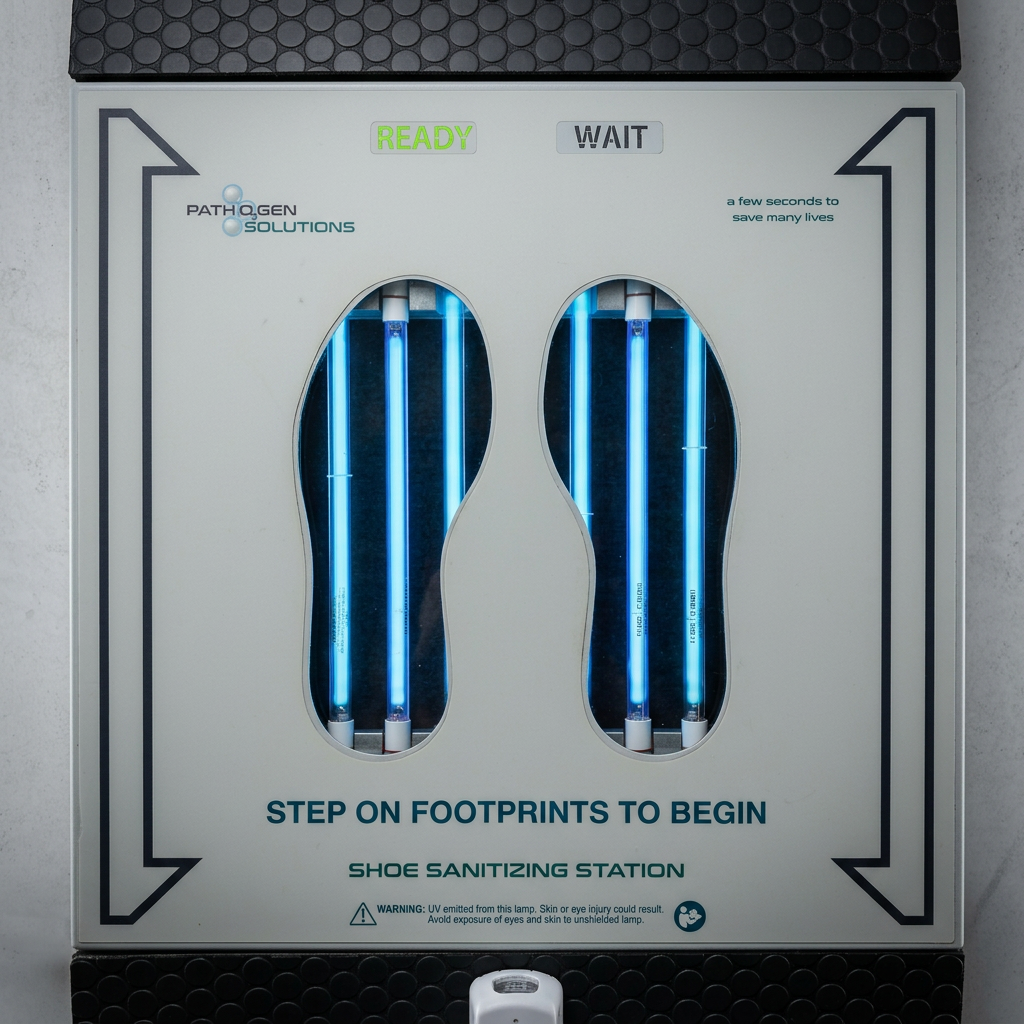
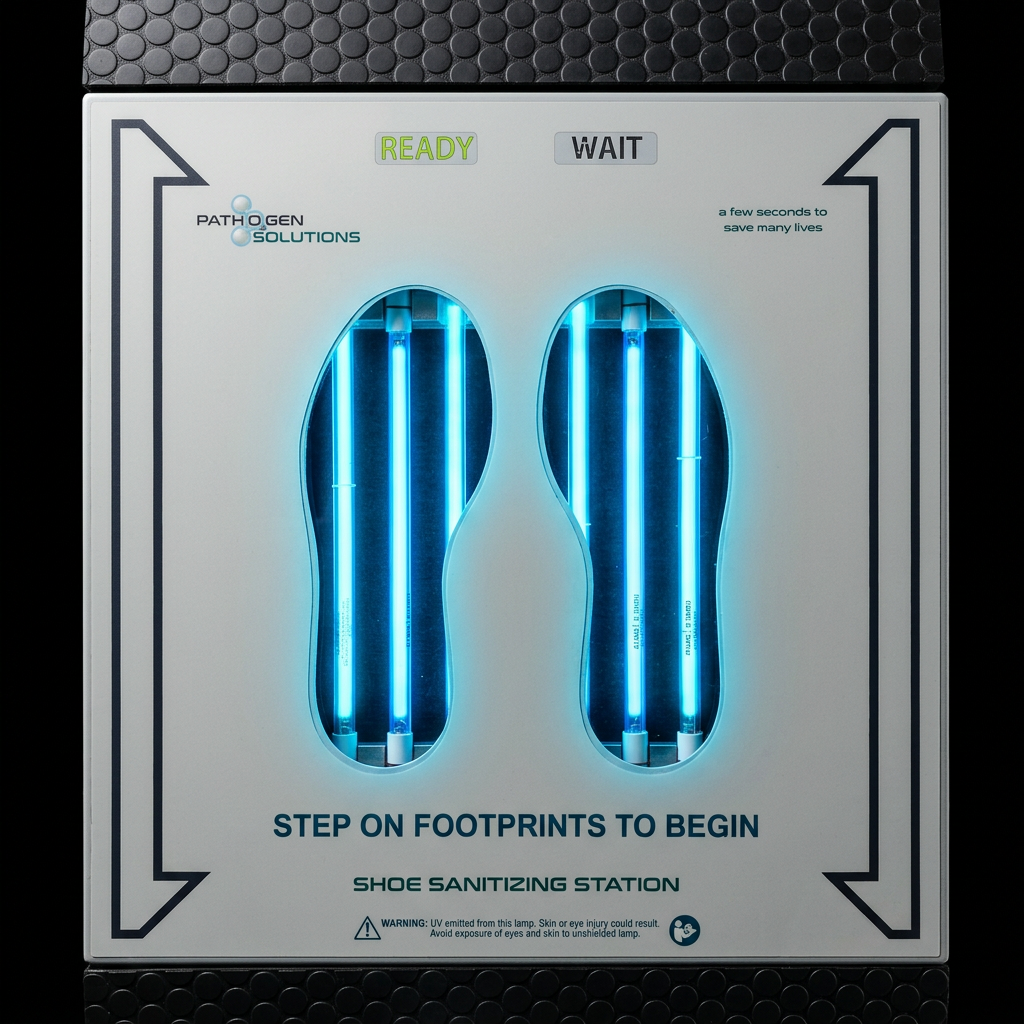
UVZone® is a floor-mounted footwear sanitizing station that uses UV-C light and ozone to treat both shoe soles during an automatic 8-second factory-set cycle.
Place the station at selected employee and hygiene transitions before personnel enter production, ready-to-eat, ingredient-handling, packaging, laboratory, or other controlled food-manufacturing areas.
UVZone® gives your team a dry, repeatable shoe-sole sanitation step without operating a liquid reservoir or requiring the user to handle a disposable item at the station.
- 8 Seconds
- Factory-set shoe-sole treatment cycle (default)
- UV-C + Ozone
- Both technologies operate during the same cycle
- Automatic Activation
- No button or external control is required for activation.
- Foodborne Organism Testing
- Published testing includes Salmonella enterica, Listeria monocytogenes, and Cronobacter sakazakii
- Up to >99.998%
- Highest reported reduction among the foodborne organisms listed in Microchem Laboratory report NG19887
Published efficacy results are organism-specific and were recorded under the laboratory conditions stated in each report. Results vary by organism, method, surface, treatment time, and application conditions.
Discuss Your Food Facility Entries
Tell us which personnel or hygiene transitions you are reviewing. Our team will follow up about station placement, operating requirements, laboratory documentation, pricing, and next steps.
Footwear crosses facility zones
Add Shoe-Sole Sanitizing at the Point Where Personnel Enter
- Employees, visitors, contractors, and service teams use many plant areas before a food-production entry.
- Parking, offices, restrooms, warehouses, and receiving are part of that daily path.
- The same footwear crosses into controlled production or hygiene zones.
- Microorganisms on shoe soles can move across that transition.
- UVZone® addresses the shoe sole at the doorway.
- The station adds a defined shoe-sole sanitizing step before personnel enter the selected area.
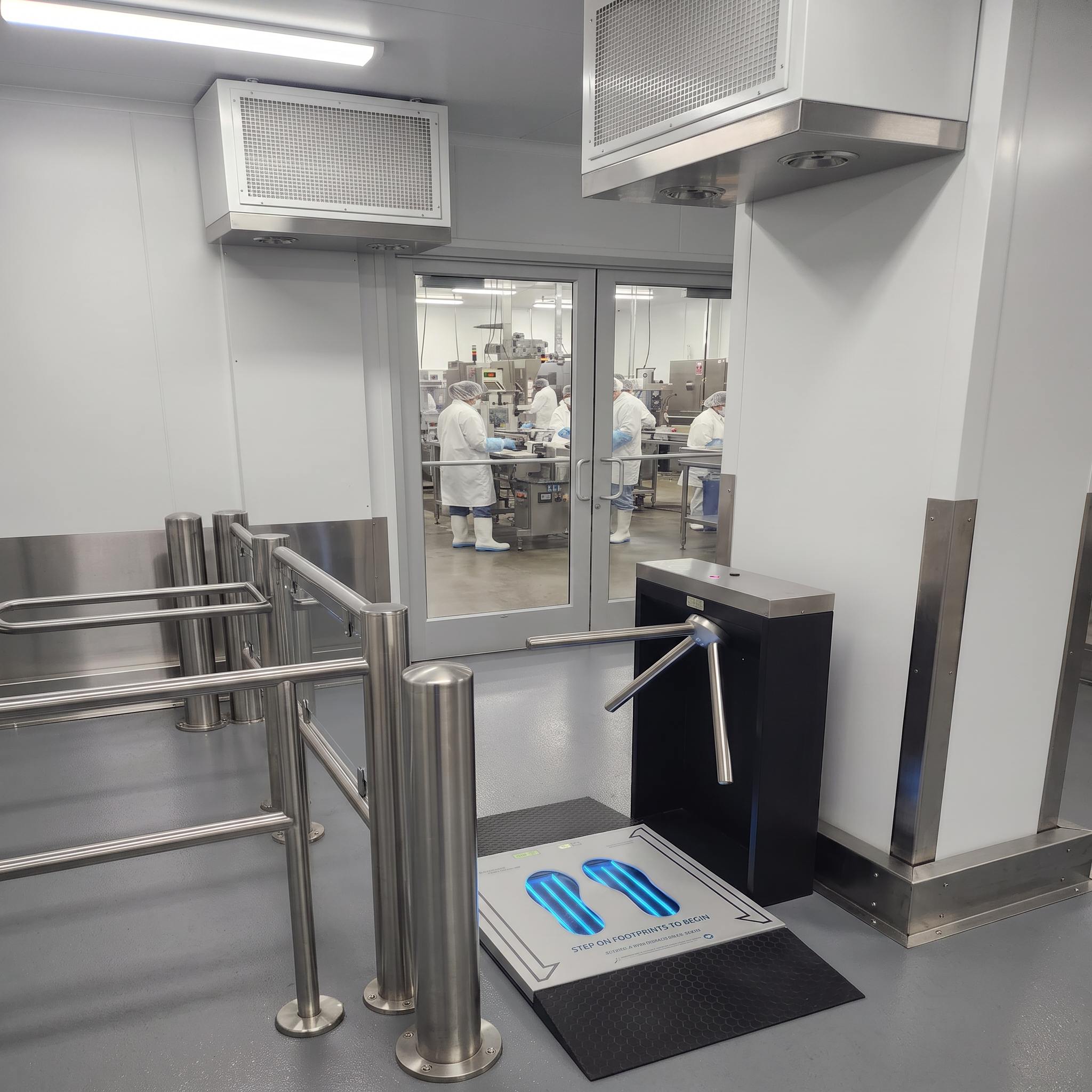
Address Footwear Before It Crosses the Entry
Place UVZone® where personnel move from a general facility area into a selected production, packaging, ready-to-eat, laboratory, or higher-hygiene zone.
Give Every User the Same Timed Process
The factory-set cycle provides a repeatable step for employees, visitors, contractors, and other approved users.
Make the Entry Step Easy to Identify
The floor-mounted station, designated footwear positions, visual indicators, and audible completion signal make the required step clear at the point of use.
One automatic shoe-sole cycle
See How UVZone® Works in 3 Easy Steps
UVZone® is designed to become a defined step in the normal personnel-entry process. The station activates automatically and treats both shoe soles during one timed cycle.
Step 1
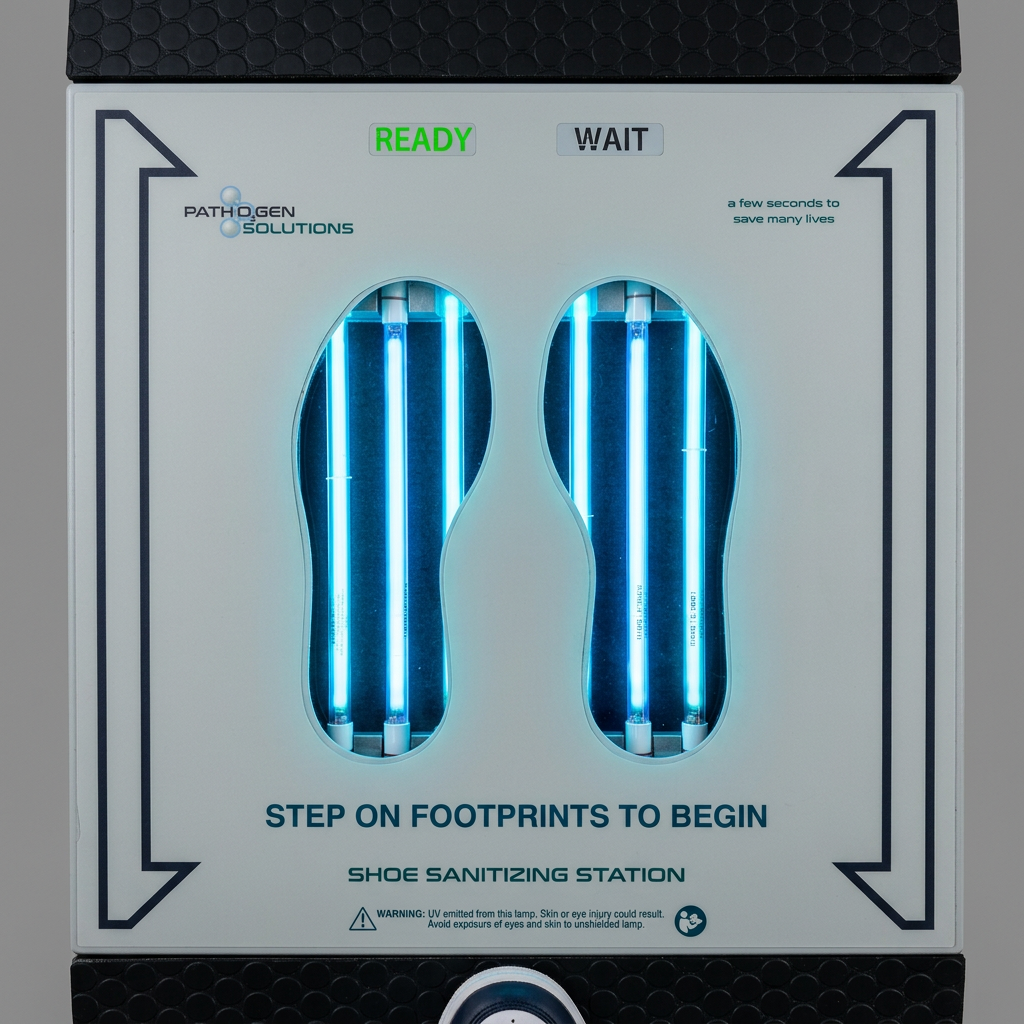
Step Onto UVZone®
Position both feet on the designated treatment areas. No button or external control is required for activation.
Step 2
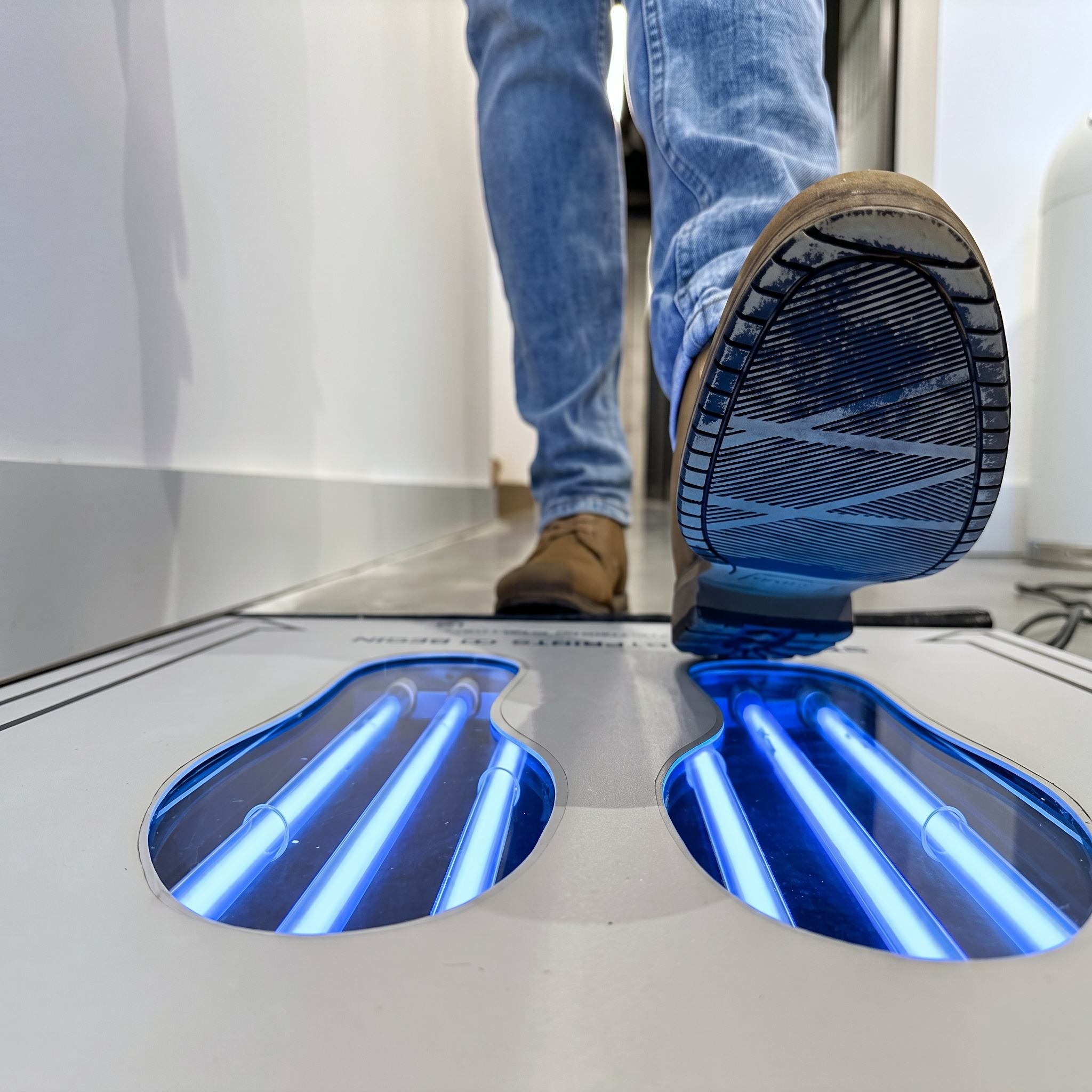
Remain in Place for the Timed Cycle
UV-C light and ozone operate together during the factory-set cycle to reduce microbial contamination on both shoe soles.
Step 3
Continue After the Completion Signal
Visual and audible indicators tell the user when the cycle is complete and they can continue through the entry.
The user does not need to press a button, handle a control, step into liquid, or remove a disposable item after completing the UVZone® cycle.
UVZone® does not remove visible soil or physical debris. Footwear must meet your facility's cleaning and condition requirements before the sanitation cycle. Keep mechanical boot cleaning, scraping, washing, or other soil-removal steps where your procedure requires them.
A defined role in your sanitation program
You Can Add Footwear Sanitizing to Selected Hygiene Transitions
- Food facilities layer controls for personnel, zoning, equipment, surfaces, environment, and movement between areas.
- UVZone® gives your food safety and sanitation teams a footwear control to review at selected personnel entries.
- The station can support Prerequisite Programs and Sanitation Standard Operating Procedures when your facility approves role, placement, cycle, maintenance, and instructions.
- Your food safety team decides which entries require the station and which personnel must use it.
- Your team documents cycle time, visible-soil requirements, cleaning, maintenance, and completion documentation. Cycle time is factory-set before shipment.
- Existing mats, washing, footwear, PPE, and hygiene steps may still apply alongside the station.
- Performance review stays within your facility's existing program.
Supports Prerequisite Programs
UVZone® can support a defined footwear-sanitation step within the facility programs that support routine food-production hygiene.
Supports Sanitation Standard Operating Procedures
Your team can define the station location, approved user group, factory-set cycle time, cleaning requirements, and operating responsibilities within the applicable procedure.
Helps Reduce Footwear Bioburden
The automatic UV-C and ozone cycle treats both shoe soles before personnel continue through the selected entry.
Provides Product and Laboratory Documentation
We provide available product specifications, operating information, laboratory reports, maintenance guidance, certification records, and current warranty information for your review.
Where Could UVZone® Fit in Your Sanitation Program?
Tell us which personnel entries you are reviewing and how footwear is handled there today.
Compare the work required at the entry
UVZone®, Chemical Mats, Boot Washing, and Covers Serve Different Roles
The correct footwear process depends on the entry, visible soil conditions, facility procedures, hygienic zone, and reason the control is being used.
We help your team compare the actual user steps, supplies, utilities, maintenance, and documentation required by each method.
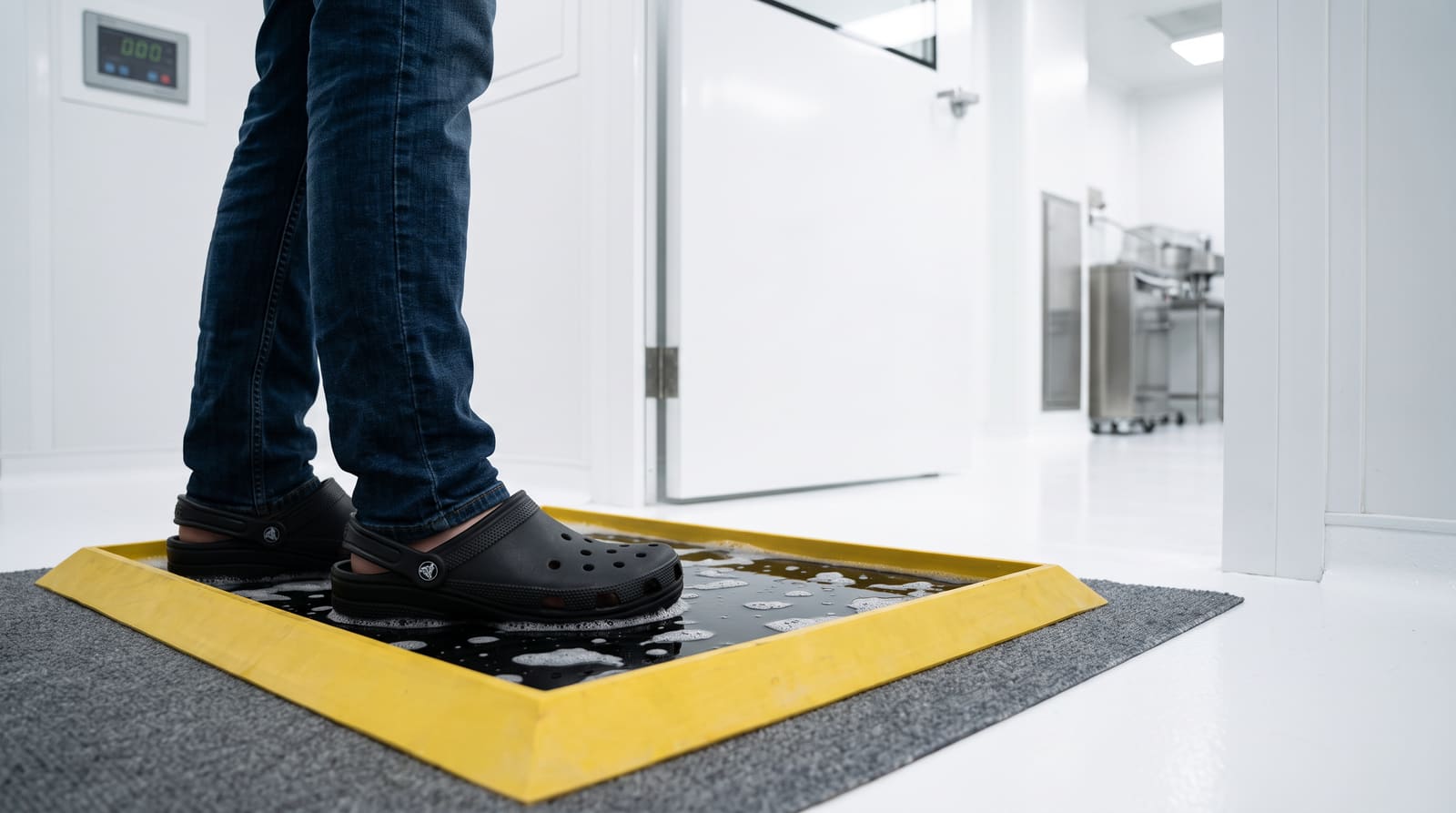 Chemical bath mat in use
A Wet Process Requiring Chemistry Management
Chemical mats and footbaths require the correct chemical, concentration, liquid level, contact procedure, replacement schedule, cleaning, monitoring, and disposal. The facility must also account for organic loading, dilution, evaporation, tracked liquid, and the surrounding floor condition.
- Chemical purchasing and storage
- Preparation or concentration control
- Liquid-level monitoring
- Contact-time procedure
- Solution replacement
- Organic-load management
- Mat or tray cleaning
- Used-solution disposal
- Wet floor and tracking controls
- Operating records where required
UVZone® Delivers a Timed Shoe-Sole Cycle Without Wet Chemistry Management
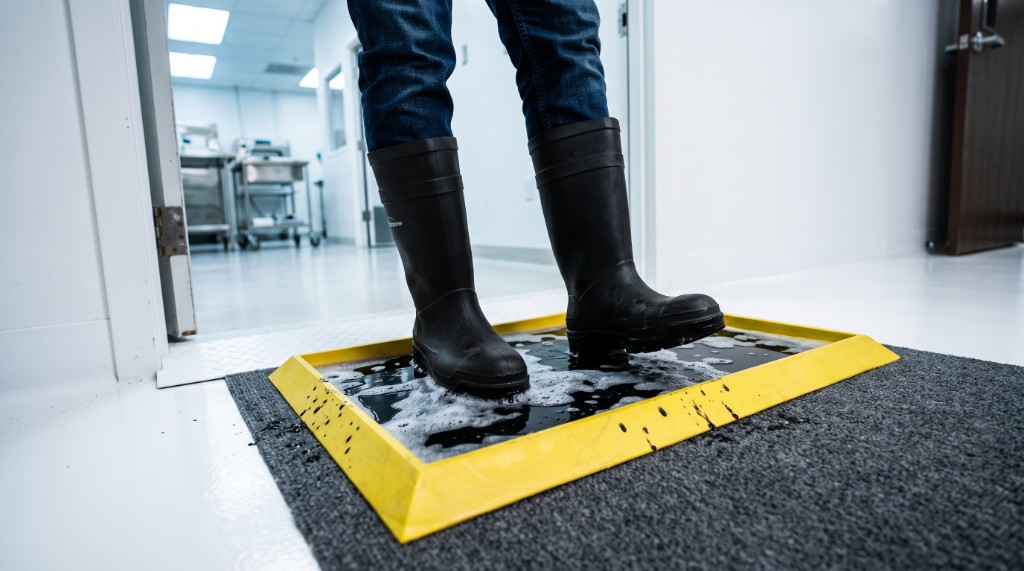 Boot washing in use
Physical Cleaning for Soil and Debris Removal
Boot washers, brushes, scraping, and manual cleaning remove visible soil, food residue, grease, mud, and other material from footwear. UVZone® does not perform that physical cleaning function. Where footwear arrives visibly soiled, your facility may require mechanical cleaning before the UVZone® cycle or may determine that a separate boot-washing process remains necessary.
- Water or cleaning solution where applicable
- Brushes, spray, or mechanical components
- Soil and debris removal
- Drainage
- Equipment cleaning
- Maintenance
- User completion of the physical cleaning step
UVZone® Sanitizes Shoe Soles After Your Approved Soil-Removal Step
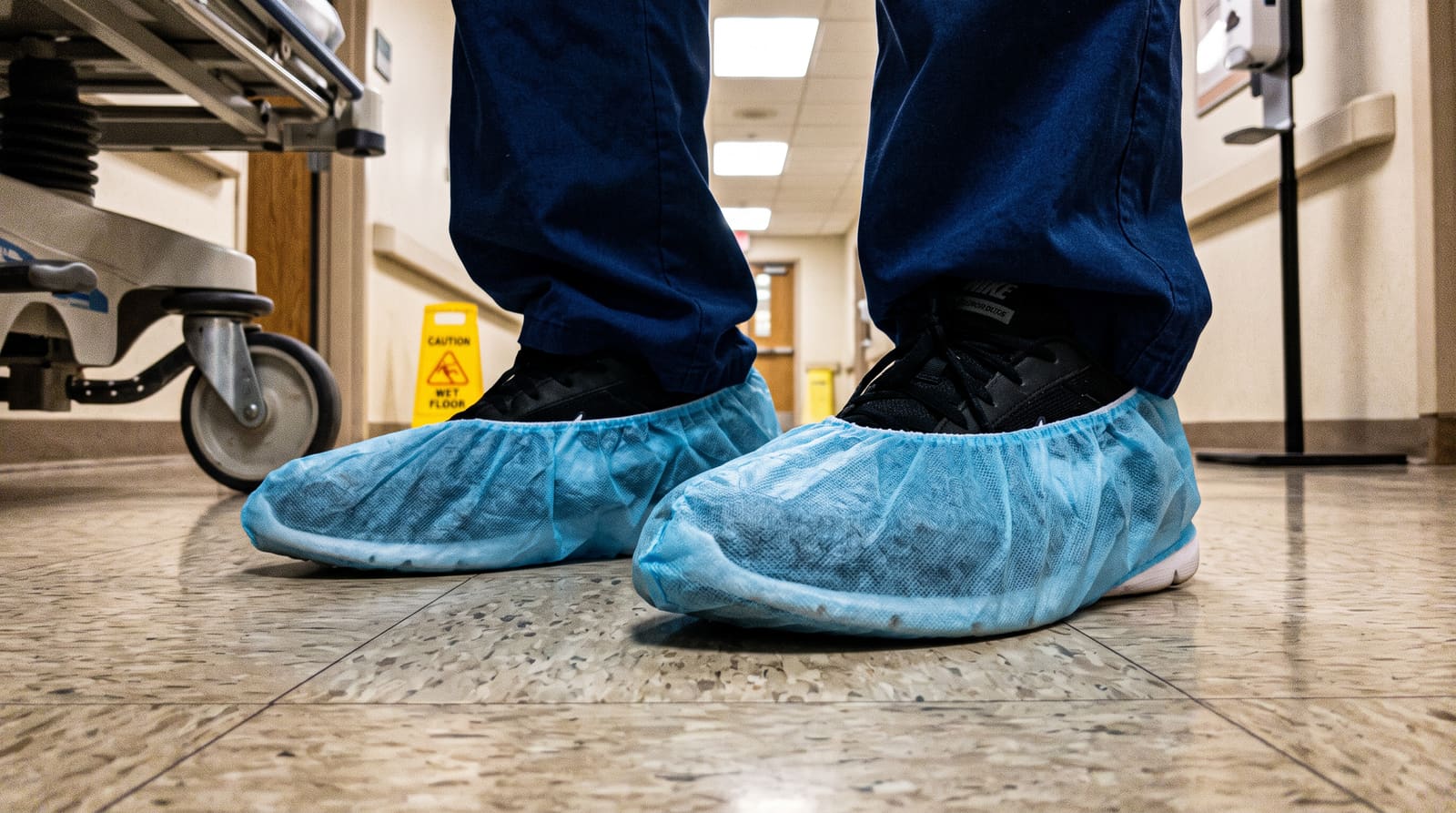 Shoe or boot covers in use
A Single-Use Barrier With Recurring Supply Handling
Disposable covers require purchasing, size management, storage, restocking, correct donning, proper removal, used-cover handling, and waste disposal. They may remain necessary where the facility uses them as part of an approved barrier, PPE, or visitor procedure.
- Recurring inventory
- Size availability
- Storage at the entry
- Restocking across shifts
- Correct donning and fit
- Replacement of torn covers
- Correct removal
- Used-cover collection
- Waste disposal
UVZone® Stays Fixed at the Entry Without Recurring Cover Inventory or Waste
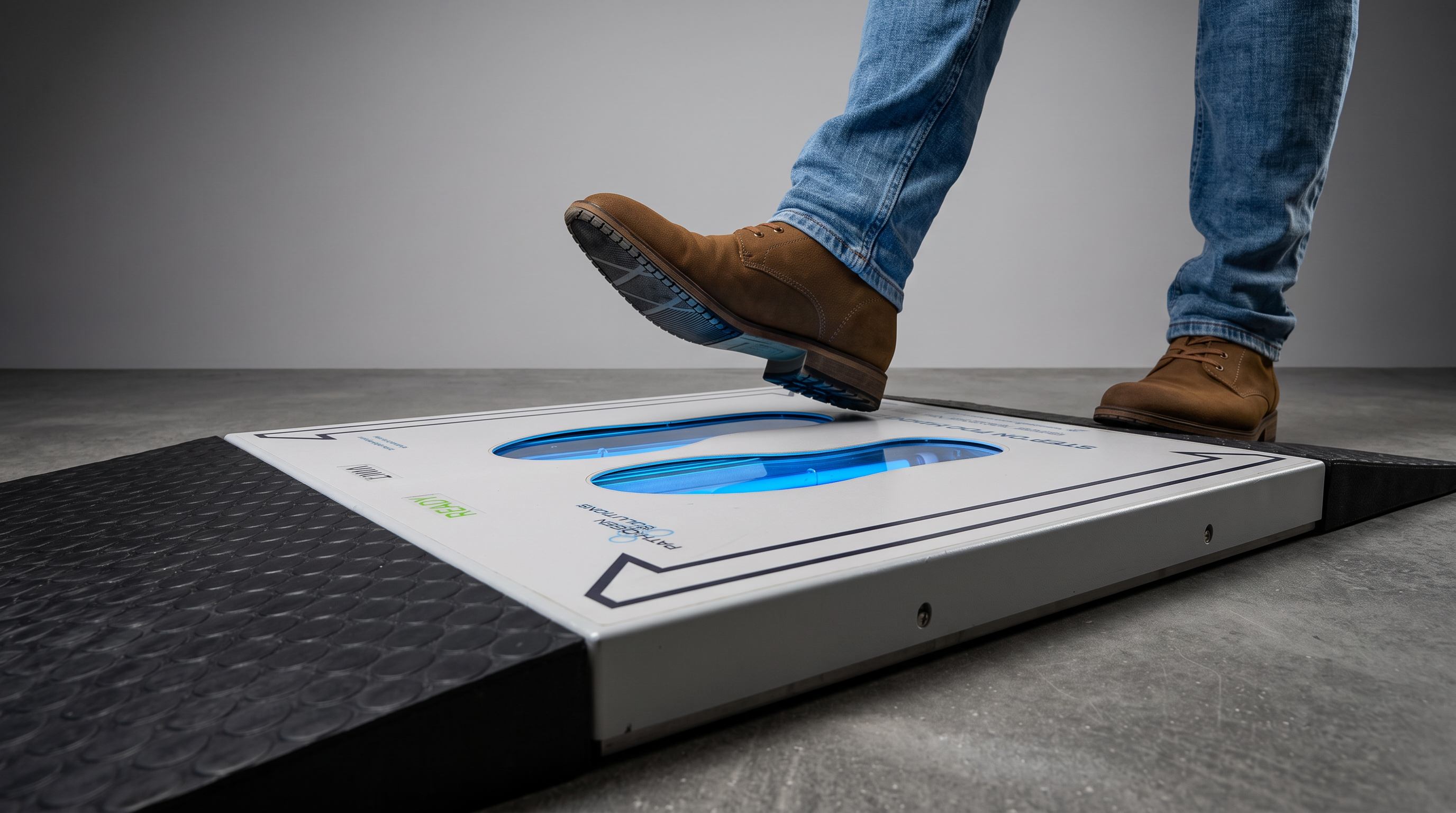 UVZone® station in use
Fixed Equipment With One Timed Shoe-Sole Cycle
UVZone® remains at the selected entry. Each approved user steps onto the station, completes the factory-set timed cycle, and continues after the completion signal. The station requires clear floor space, electrical power, an approved operating procedure, footwear that meets the facility’s condition requirements, and planned cleaning and maintenance.
- 24 × 24-inch station footprint
- Two-inch station height
- 120 to 240 VAC electrical input
- Clear walking and door path
- Selected cycle time
- Defined user procedure
- Cleaning access
- Planned lamp and equipment maintenance
- Facility approval before placement
Why Food Facilities Evaluate UVZone® for Repeatable, Hands-Free Shoe-Sole Sanitizing at Selected Entries
UVZone® may reduce reliance on wet chemical mats or disposable covers at appropriate entries. It may also follow an approved soil-removal step when footwear requires physical cleaning. Your facility determines which cleaning, PPE, footwear, washing, and sanitation procedures remain necessary.
Select the right hygiene transitions
Place UVZone® Where Personnel Enter Controlled Production Areas
UVZone® does not have to be installed at every door.
Start with personnel entries where footwear moves into a selected production or hygiene zone, where users already stop for another sanitation step, or where your food safety team has identified footwear as a microbial concern.
Main Production Employee Entrances
Add UVZone® where employees complete handwashing, PPE, footwear, or other hygiene steps before entering production. The station may be positioned as one defined part of the entry sequence after any required visible-soil removal.
Personnel Entries Serving Ready-to-Eat Areas
Evaluate UVZone® at selected personnel entries serving ready-to-eat, post-process, exposed-product, or other higher-hygiene areas identified by the facility. Your food safety team determines how the station fits the site’s hygienic zoning, footwear, PPE, sanitation, and traffic procedures.
General-to-Production Personnel Transitions
Place the station where approved personnel move from offices, breakrooms, restrooms, general corridors, or other nonproduction areas into the production environment.
Ingredient-Handling and Processing Entries
Evaluate UVZone® at selected personnel entries serving ingredient preparation, mixing, processing, batching, or other controlled food-production areas.
Packaging Personnel Entries
Add a defined shoe-sole sanitation step before approved personnel enter selected primary packaging, secondary packaging, or finished-product operating areas.
Quality Control and Laboratory Entries
Position UVZone® before approved personnel enter selected quality, microbiology, product-testing, or controlled technical laboratories.
Controlled Visitor and Service Entrances
Give visitors, contractors, vendors, and maintenance personnel the same timed footwear step before they enter selected production or hygiene areas.
Our team reviews personnel traffic, doorway dimensions, floor space, door movement, nearby power, surrounding equipment, cleaning access, visible-soil conditions, and the current entry procedure before recommending placement.
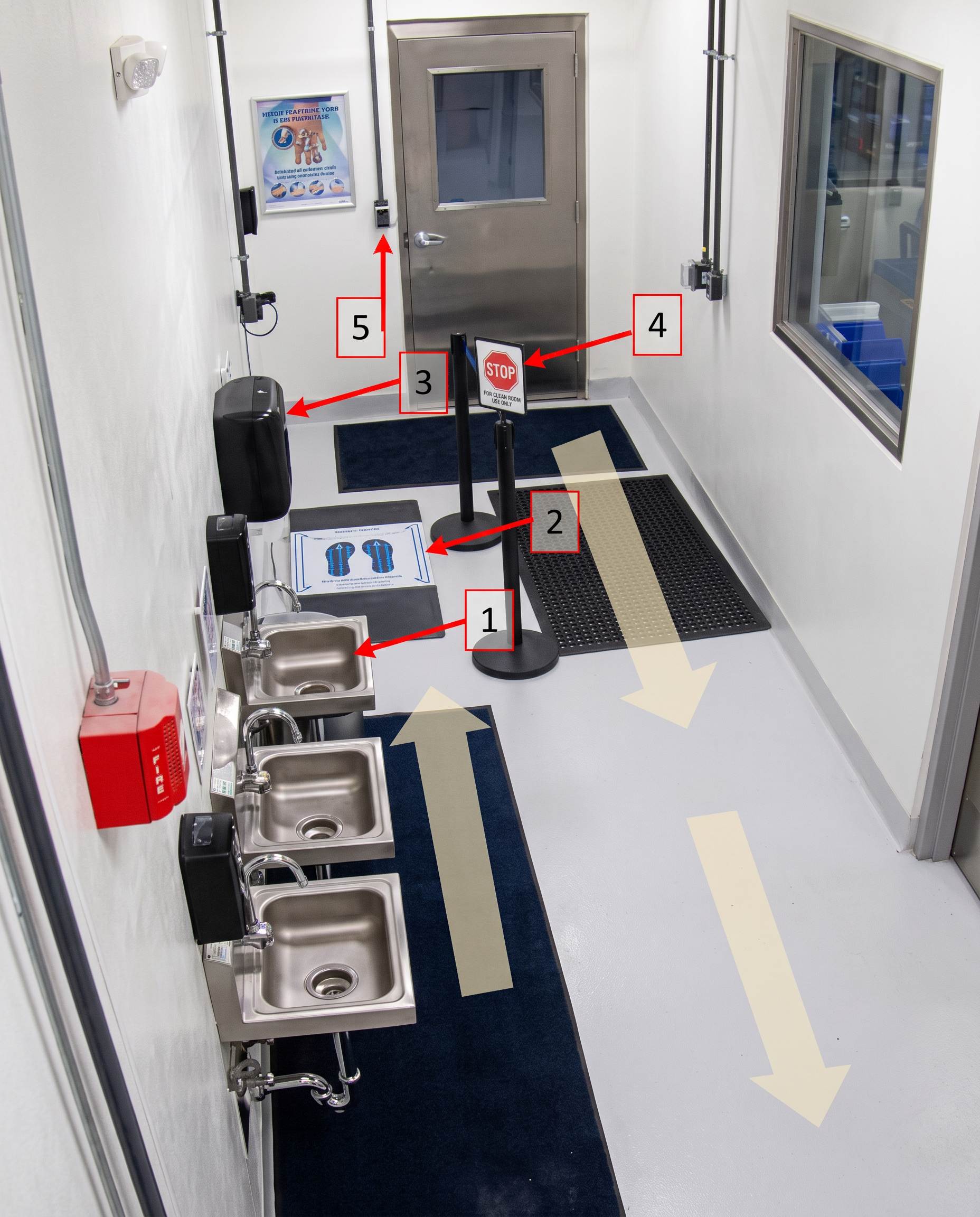
Organism-specific laboratory results
Independent Testing Against Foodborne Organisms
Microchem Laboratory tested UVZone® against multiple foodborne organisms under controlled laboratory conditions.
Each published result is specific to the organism, carrier surface, test method, laboratory, report, and treatment time stated in the documentation.
- Up to >99.998%
- Highest reported reduction among the foodborne organisms shown in Microchem Laboratory report NG19887
- 6 to 8 Seconds
- Treatment times reported for the foodborne organisms shown
- Three Foodborne Organisms
- Salmonella enterica, Listeria monocytogenes, and Cronobacter sakazakii
- Full Report Available
- Provide the complete laboratory documentation for food safety and technical review
Salmonella enterica
- Reported reduction
- >99.998%
- Treatment time
- 6 seconds
- Laboratory
- Microchem Laboratory
- Report ID
- NG19887
glass carriers simulating shoe soles under modified ASTM E1153 laboratory conditions
Listeria monocytogenes
- Reported reduction
- >99.994%
- Treatment time
- 8 seconds
- Laboratory
- Microchem Laboratory
- Report ID
- NG19887
glass carriers simulating shoe soles under modified ASTM E1153 laboratory conditions
Cronobacter sakazakii
- Reported reduction
- >99.991%
- Treatment time
- 6 seconds
- Laboratory
- Microchem Laboratory
- Report ID
- NG19887
glass carriers simulating shoe soles under modified ASTM E1153 laboratory conditions
Efficacy claims are based on independent laboratory testing. Results may vary based on application conditions. PathO3Gen technology is designed for environmental surface sanitation and is not intended to diagnose, treat, cure, or prevent any disease. Laboratory testing does not establish suitability, regulatory compliance, validation, or field performance for a specific facility.
What your facility needs to review
Station Size, Electrical Input, Cycle, and Maintenance
A food-facility entry review must address both the sanitation procedure and the physical conditions at the proposed location.
- Station Footprint
- 24 inches × 24 inches
- Station Height
- 2 inches
- Station Weight
- 33 pounds
- User Weight Capacity
- Up to 400 pounds
- Treatment Settings
- Default 8 seconds (factory-set)
- Electrical Input
- 120 to 240 VAC, 50 to 60 Hz, 1.2 A
- Power Cord
- 10 feet
- Activation
- Automatic
- Cycle Completion
- Visual and audible indicators
- UV-C Wavelength
- 254 nm
- Ozone Generation
- 185 nm light generates ozone within the treatment area
- Lamp Array
- Four 254 nm lamps and two 185 nm lamps
- Published Lamp Life
- 10,000 or more operating hours to 80 percent output
- Manufacturing
- Manufactured in the United States at an ISO 9001:2015 facility
- Certification
- TÜV SÜD certified
- Warranty
- One-year parts and labor warranty, subject to the current written terms
We review the available floor space, walking path, door operation, threshold, electrical access, wet-area conditions, drainage, cleaning access, surrounding equipment, expected traffic, and footwear condition before recommending placement.
Food manufacturing experience
How Food Facilities Have Added UVZone® at Hygiene Transitions
Published customer statements describe how food manufacturing organizations have placed UVZone® within their facility procedures.
Customer experience is not a substitute for controlled laboratory testing and does not guarantee the same result at another facility.
“We have recently added the UVZone® Shoe Sanitizing Station to our transitional zone.”
This statement describes placement at a facility transition. Your plant's placement, operating procedure, and internal review should be based on its own hygiene zones, footwear conditions, traffic, and food safety program.
Start with priority hygiene transitions
We Help Your Team Evaluate UVZone® Before Deployment
You do not need to determine station locations, quantities, operating procedures, and documentation requirements from a product page alone.
We work with your food safety, sanitation, operations, facilities, and procurement teams to understand the proposed entries and determine what the station would require.
Step 1
Identify the Entries You Want to Review
Show us the employee hygiene, production, ready-to-eat, packaging, laboratory, contractor, or other personnel entries your team is reviewing.
Step 2
Explain the Current Footwear Procedure
Tell us how personnel currently use chemical mats, footbaths, boot washers, disposable covers, dedicated footwear, or other sanitation steps.
Step 3
Confirm the Physical and Operating Requirements
We review the station footprint, walking path, door movement, electrical access, cleaning access, visible-soil conditions, surrounding equipment, and expected traffic.
Step 4
Receive the Information Your Team Needs
We provide applicable product specifications, laboratory reports, placement information, maintenance information, pricing, warranty terms, and available implementation support.
Talk with PathO3Gen Solutions
Let's Review the Footwear Process at Your Production Entries
Tell us where personnel enter, which production or hygiene areas your facility is reviewing, and how footwear is handled there today.
Our team will help you determine whether UVZone® fits the entry, what the station requires, which procedures may remain necessary, and which product and laboratory documents your reviewers need.
WARNING: UV emitted from this device. Skin or eye injury could result. Avoid exposure of eyes and skin to unshielded lamp. Efficacy claims are based on independent laboratory testing. Results may vary based on application conditions. PathO3Gen technology is designed for environmental surface sanitation and is not intended to diagnose, treat, cure, or prevent any disease. Always follow manufacturer instructions and applicable facility procedures and regulations.
UVZone® does not remove visible soil or replace physical footwear cleaning where soil removal is required. The facility is responsible for reviewing station fit and approving its use within its food safety, sanitation, footwear, PPE, hygienic zoning, and operating procedures.
Use of UVZone® does not by itself establish compliance with HACCP, FSMA, GMP, GFSI-recognized certification programs, customer standards, regulatory requirements, or a facility's food safety plan.