
Candida auris
laboratory test surfaces under the conditions stated in the report
99.9993%
at 10 seconds
PathO3Gen Solutions, St. Petersburg, FL · We build UVZone® right here in America, made by Americans, never outsourced.PathO3Gen Solutions · St. Petersburg, FL · UVZone® manufactured in the USA
Our footwear sanitizing station uses UV-C and ozone to sanitize both shoes in a 6 to 10 second cycle.
Independent laboratory testing recorded up to 99.9993% pathogen reduction across published organism results.
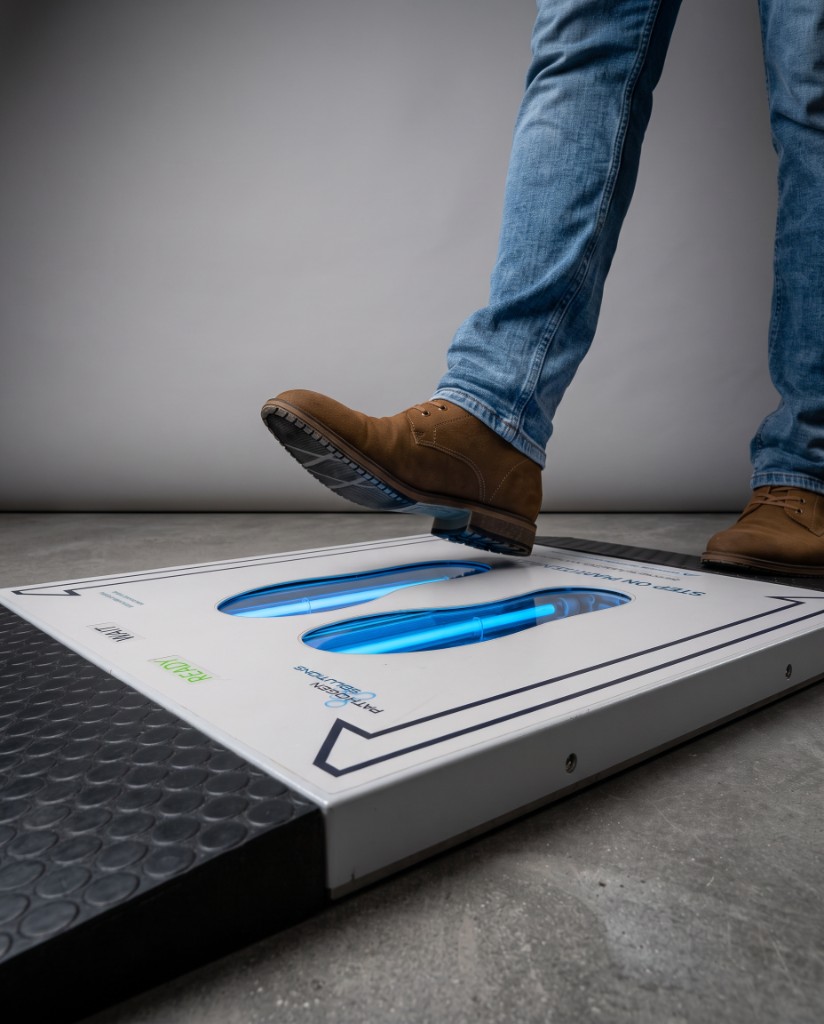
Published cycle settings, dual-action treatment, and one independent laboratory result for facility review.
Up to 99.9993%
Pathogen reduction
Candida auris · 10 seconds · NSF International Applied Research Center, report J-00340388
8 seconds
Factory-set shoe-sole treatment cycle
Cycle time is factory-set before shipment. The default is 8 seconds. PathO3Gen configures 6 or 10 seconds when your order requires it.
UV-C + Ozone
Dual-action shoe-sole treatment
Four 254 nm lamps and two 185 nm lamps operate in the same timed cycle.
Automatic
Activation when the user steps into position
No button or external control is required for activation.
U.S. COMPLIANCE SUPPORT
U.S. healthcare, food manufacturing, and pharmaceutical facilities operate under written requirements for infection prevention, sanitation, personnel practices, and microbial contamination control.
Those programs depend on people completing the required steps at the correct locations every day.
UVZone® gives your facility a repeatable shoe-sole sanitizing step that can be added to an employee entrance, hygiene station, gowning area, laboratory entry, production transition, or other controlled doorway.
Each user completes the same automatic 8-second factory-set UV-C and ozone cycle before continuing through the entry.
We provide the product specifications, operating information, laboratory reports, maintenance requirements, and placement details your quality or compliance team needs to review the station.
UVZone® does not make a facility compliant by itself. Your organization determines how the station is incorporated into its written programs, standard operating procedures, training, monitoring, and documentation.
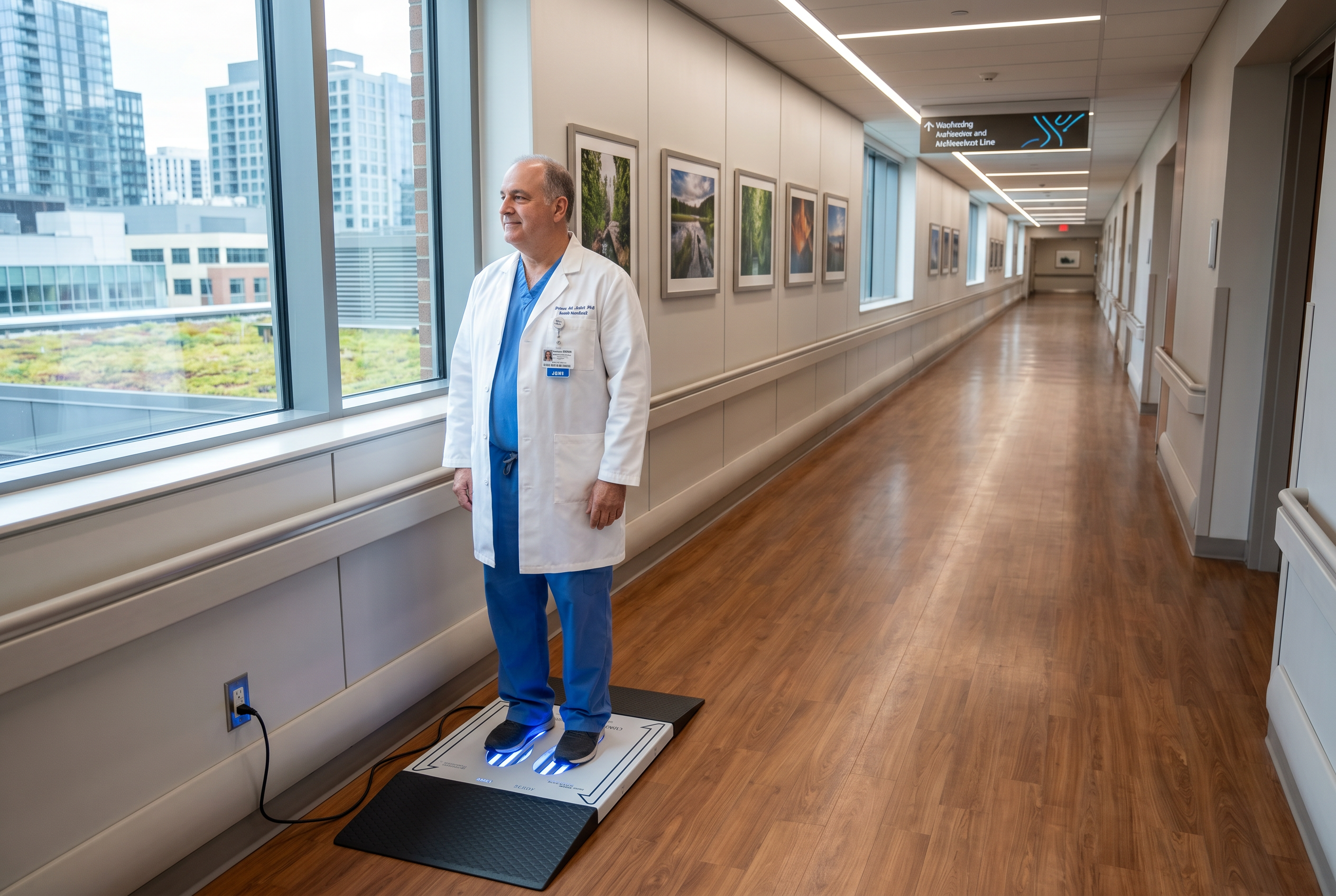
Standards and programs UVZone® can support
HealthcareSupport CMS infection prevention programs under 42 CFR § 482.42 and § 483.80.
CompoundingSupport personnel hygiene and garbing under USP General Chapter <797>, where applicable.
Food manufacturingSupport sanitation controls under FDA 21 CFR Part 117 and written SSOPs.
Meat and poultrySupport establishment sanitation under USDA FSIS 9 CFR Part 416.
Food safety programsSupport Prerequisite Programs, HACCP plans, and hygienic zoning at employee entries.
PharmaceuticalSupport CGMP personnel and contamination-control procedures under 21 CFR Parts 210 and 211.
Your facility determines how UVZone® is written into its programs. The station does not establish compliance by itself.
Review your current footwear process
Our footwear sanitizing station adds a timed, hands-free sole step at the door. We help you compare its operating requirements with the cover or chemical mat process your facility uses today.
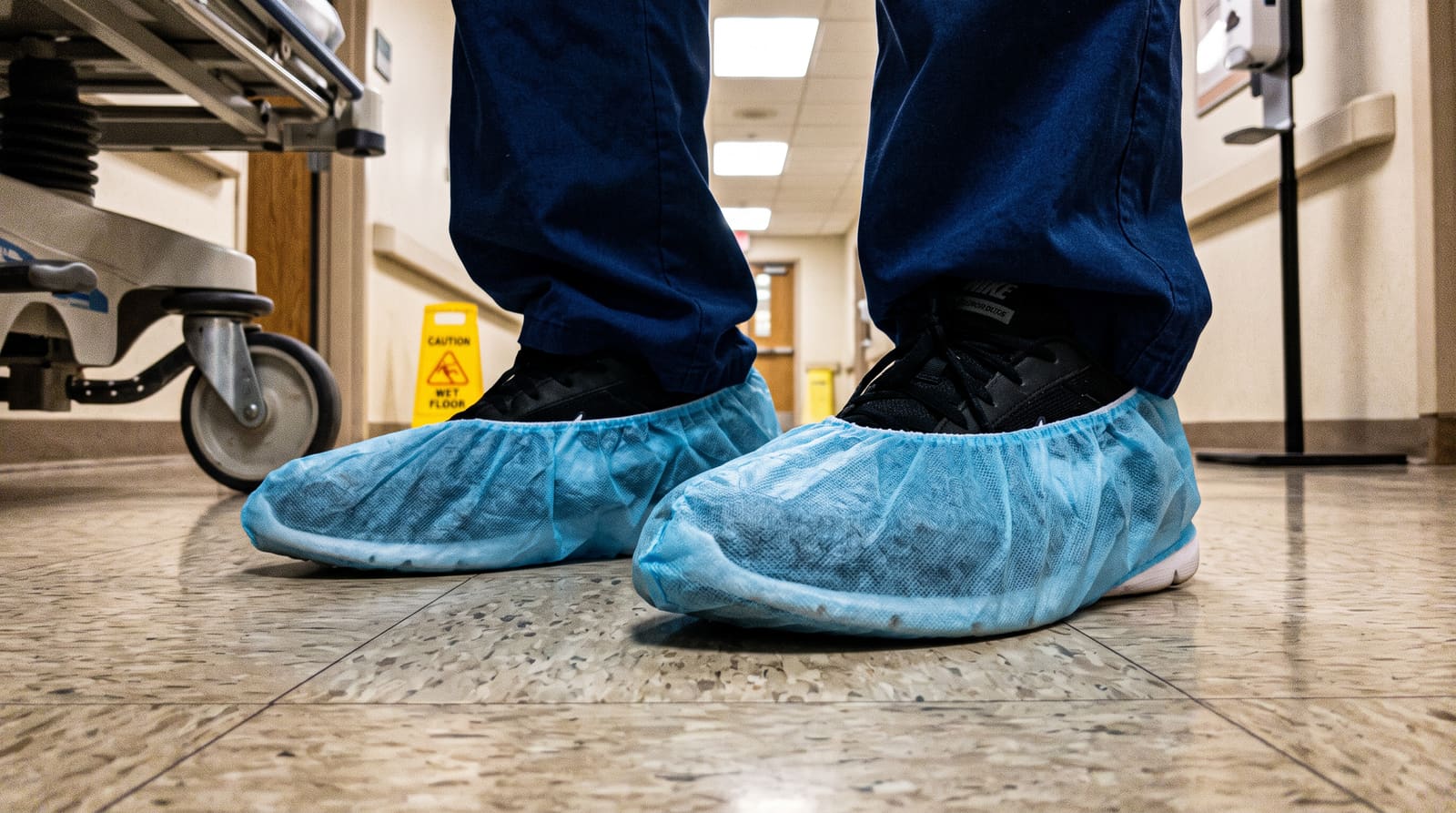
Disposable covers create a barrier over footwear. Your process must account for purchasing, storage, restocking, correct donning and removal, used-cover handling, and waste at every participating entry.
Your current process may include
UVZone® provides a timed UV-C and ozone shoe-sole cycle. Keep covers and PPE where your program requires them, and review the station at entries where a fixed footwear step fits your procedure.
Compare your shoe cover process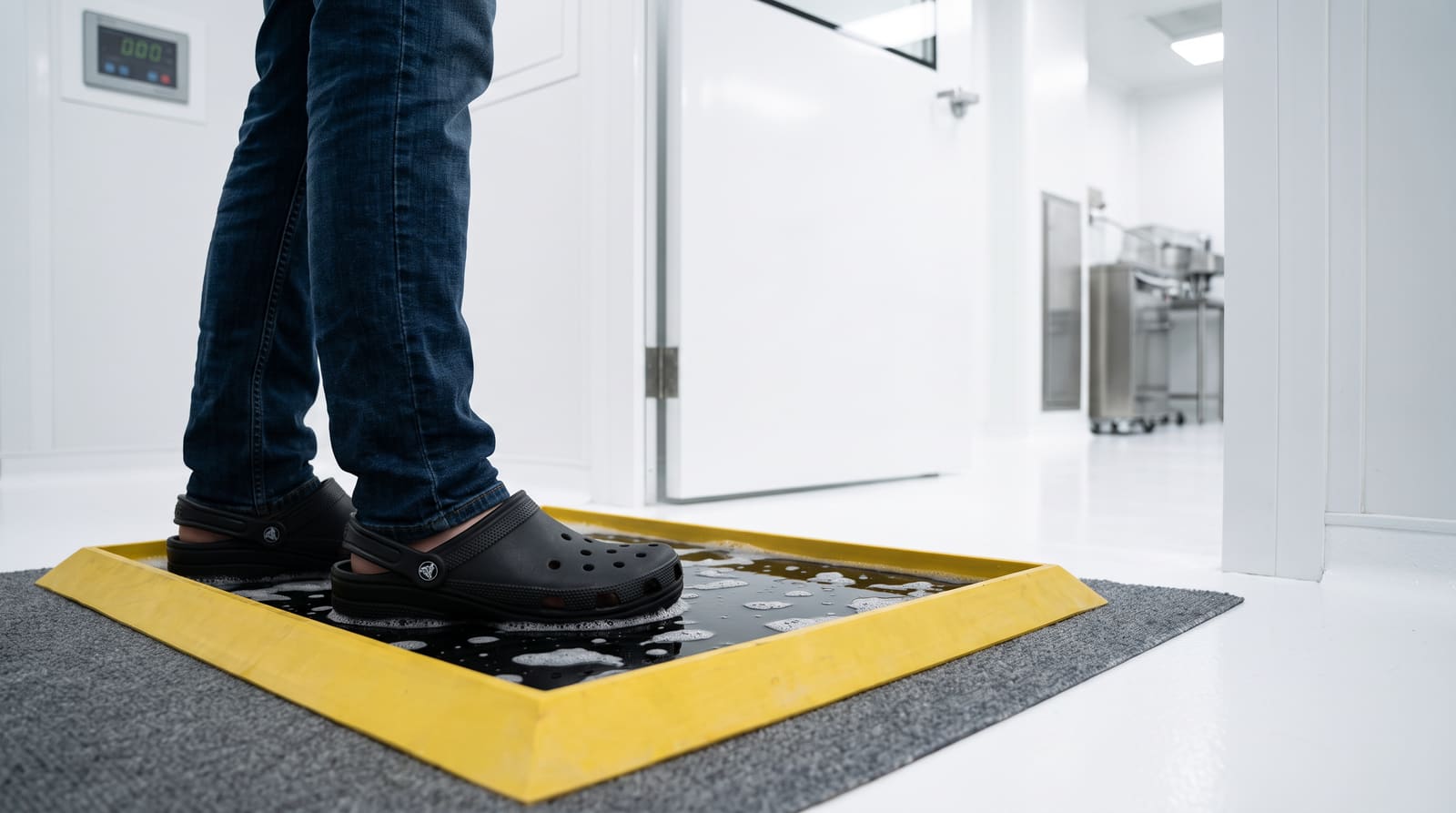
Chemical foot mats require chemical selection, concentration control, liquid-level monitoring, solution replacement, debris removal, used-solution handling, and records at each participating entry.
Your current process may include
UVZone® uses a dry, automatic cycle without a liquid reservoir at the door. Keep wet chemistry where your program requires it, and compare the operating requirements at the entries you are reviewing.
Compare your chemical mat processEvery facility runs different entry protocols. We can work with your team to review your layout, traffic patterns, and operating requirements, and help you decide whether UVZone® fits your program.
Healthcare
Hospitals participating in Medicare and Medicaid must maintain an active infection prevention and control program under CMS Conditions of Participation.
Long-term care facilities must maintain an infection prevention and control program with written standards, policies, procedures, surveillance, reporting, and corrective-action requirements.
UVZone® can support a repeatable footwear sanitation step at employee entrances, pharmacy entries, clinical laboratories, procedural transitions, skilled nursing entrances, assisted living entrances, and other locations identified by the facility’s infection prevention team.
Required qualification: UVZone® does not replace hand hygiene, environmental cleaning, isolation precautions, PPE, garbing, dedicated footwear, disposable shoe covers, or any procedure required by the healthcare organization.
See UVZone® for Healthcare Compliance ProgramsFood Manufacturing and Processing
Food manufacturers subject to the FDA Preventive Controls for Human Food rule must establish written preventive controls appropriate to the facility and the food being produced.
Those controls may include sanitation procedures addressing environmental pathogens, employee practices, insanitary objects, and cross-contamination between facility areas.
USDA-inspected meat and poultry establishments must also maintain sanitation procedures under 9 CFR Part 416.
UVZone® can support a dry, repeatable footwear sanitation step at employee hygiene entrances, general-to-production transitions, ready-to-eat entries, ingredient-handling areas, packaging rooms, cold-storage entries, and quality laboratories.
Required qualification: UVZone® treats shoe soles for microbial reduction. It does not remove visible soil, food residue, grease, mud, or physical debris. Keep boot washing, brushing, scraping, or other cleaning procedures wherever physical soil removal is required. UVZone® does not by itself establish compliance with FSMA, HACCP, USDA requirements, GFSI-recognized certification programs, customer requirements, or a facility’s food safety plan.
See UVZone® for Food Compliance ProgramsPharmaceutical and Biotechnology
Pharmaceutical manufacturers operating under FDA Current Good Manufacturing Practice requirements must maintain appropriate personnel sanitation practices, control access to limited areas, and establish written procedures for controlling objectionable or microbiological contamination.
FDA guidance for sterile drug manufacturing also addresses personnel practices, gowning, facility layout, and personnel movement through aseptic processing areas.
UVZone® can support an additional footwear bioburden reduction step at gowning rooms, personnel anterooms, cleanroom entrances, compounding areas, quality-control laboratories, microbiology laboratories, and controlled manufacturing entries.
Required qualification: UVZone® does not establish CGMP compliance, process validation, cleanroom classification, sterility assurance, or suitability for a specific pharmaceutical process. It does not replace required gowning, dedicated footwear, shoe covers, PPE, environmental monitoring, validated cleaning, or other procedures required by the site quality system.
See UVZone® for Pharmaceutical Compliance ProgramsMake the footwear step part of the written process
A compliance program needs more than equipment sitting near an entrance.
Your facility must determine where UVZone® is required, who must use it, which factory-set cycle applies, how the equipment is maintained, and how the procedure is communicated to personnel.
Our team helps you review the operating details needed to incorporate the station into your facility documentation.
Identify the exact employee entrance, hygiene transition, gowning area, laboratory entry, or production doorway where the station will be used.
Define whether the procedure applies to employees, visitors, contractors, service personnel, or other groups entering the area.
Document the factory-set cycle time for that location. Cycle time is set before shipment. The default is 8 seconds. Your facility documents the cycle based on its review of the available product and laboratory information.
Document correct foot placement, completion indicators, entry sequence, footwear condition requirements, and the actions personnel take after the cycle.
Assign responsibility for routine inspection, cleaning, lamp monitoring, component replacement, service, and maintenance records.
Maintain the applicable product specifications, operating instructions, laboratory reports, certification records, warranty information, and facility approval documents.
UVZone® can support infection prevention, sanitation, SSOP, PRP, hygienic zoning, contamination control, and personnel-entry procedures at the point where footwear enters a controlled area.
Our team will review the proposed entry, current footwear process, traffic flow, floor space, power requirements, and factory-set cycle options. We will also provide the product specifications, independent laboratory reports, operating information, and maintenance documentation your facility needs to review the station.
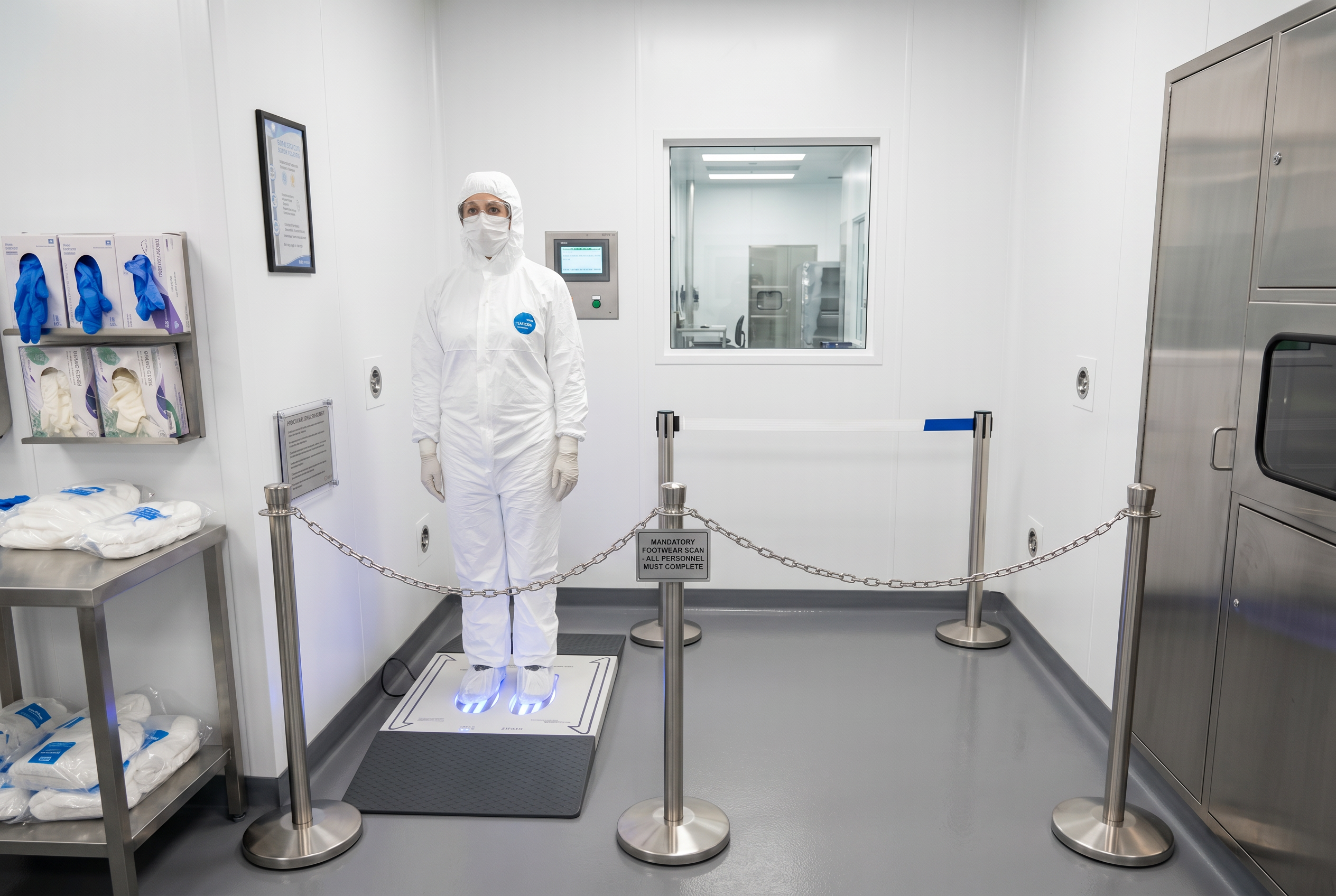
Our footwear sanitizing station is designed for normal facility entry. UVZone® activates automatically and provides visual and audible indicators during the treatment cycle.
Position both feet on the designated treatment areas. No button or external control is required for activation.
UV-C light and ozone operate together to treat both shoe soles during the factory-set cycle. The default is 8 seconds.
A visual indicator and audible signal tell the user when the cycle is complete and they can continue through the entry.
The dry cycle runs without a liquid reservoir at the station or a disposable cover to remove after the UVZone® step.
Dual-action technology
Shoe soles have tread patterns, recessed areas, seams, and surface texture. We designed UVZone® around four 254 nm lamps and two 185 nm lamps that combines 254 nm UV-C light and ozone generated by 185 nm light during the same timed cycle.
UVZone® uses germicidal 254 nm UV-C light to treat exposed shoe-sole surfaces during the timed cycle.
A 185 nm wavelength generates ozone within the treatment chamber. Published specifications state approximately 1 ppm in the chamber.
Four 254 nm UV-C lamps. Two 185 nm lamps generate ozone within the treatment chamber.
UV-C and ozone operate during the same automatic factory-set cycle. The default is 8 seconds.
Protect the right entry points
UVZone® belongs where footwear enters a controlled area. We help you identify doors and transitions where a shoe-sole sanitizing step fits your traffic flow and current entry procedure.
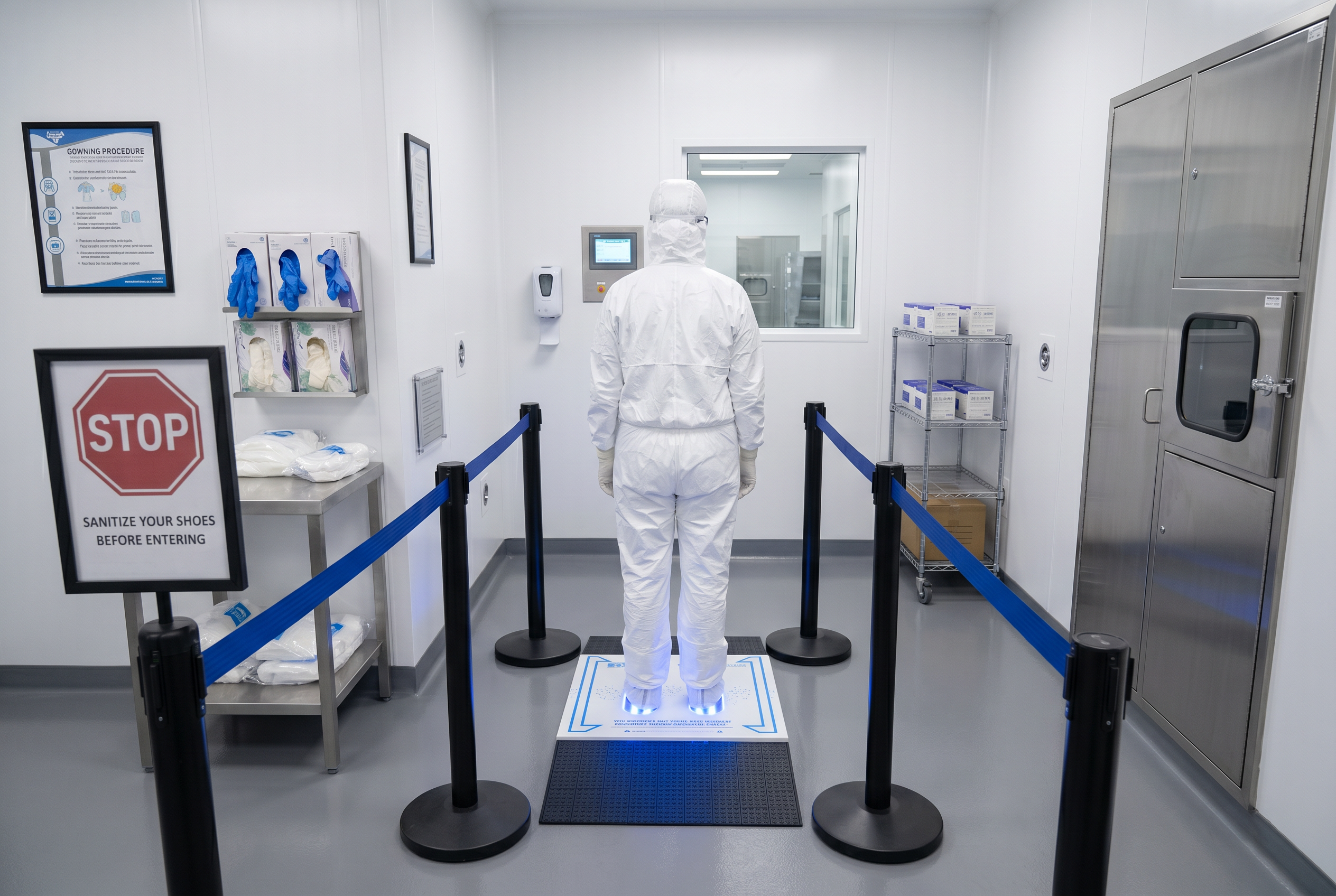
Show us the entries you are reviewing. We will review traffic direction, floor space, door clearance, nearby power, and expected daily use with your team.
UVZone® design specifications
Our shoe sanitizing station has a low-profile 24 × 24 × 2 inch floor footprint, weighs 33 pounds, and supports users up to 400 pounds. It connects to a 120-240VAC outlet, runs a factory-set timed cycle with an 8-second default, and activates automatically when the user steps into position. No button or external control is required for activation.
We will account for floor area, travel direction, electrical access, door clearance, surrounding equipment, and expected daily use.
Independent laboratory testing
Independent laboratories have tested UVZone® against organisms relevant to healthcare, food processing, and controlled facilities. Results vary by organism, method, surface, and treatment time. Full reports are available for technical review.
Up to 99.9993%
Pathogen reduction
Candida auris · 10 seconds · NSF International Applied Research Center, report J-00340388. Tested on laboratory test surfaces under the conditions stated in the report.
Published registry results include Candida auris, Staphylococcus aureus, Clostridioides difficile, Enterococcus faecalis / VRE, Pseudomonas aeruginosa, Escherichia coli, and Klebsiella pneumoniae.
Published registry results include Salmonella enterica, Listeria monocytogenes, and Cronobacter sakazakii.
Published registry results include Murine Norovirus as a surrogate for human norovirus.
Independent laboratory efficacy testing against healthcare-associated pathogens.
laboratory test surfaces under the conditions stated in the report
99.9993%
at 10 seconds
laboratory test surfaces under the conditions stated in the report
99.9989%
at 10 seconds
laboratory test surfaces under the conditions stated in the report
99.9986%
at 10 seconds
laboratory test surfaces under the conditions stated in the report
99.9976%
at 8 seconds
laboratory test surfaces under the conditions stated in the report
99.9969%
at 10 seconds
laboratory test surfaces under the conditions stated in the report
99.9960%
at 10 seconds
laboratory test surfaces under the conditions stated in the report
99.9867%
at 8 seconds
laboratory test surfaces under the conditions stated in the report
5.16 log₁₀
at 10 seconds
laboratory test surfaces under the conditions stated in the report
4.51 log₁₀
at 10 seconds
laboratory test surfaces under the conditions stated in the report
4.40 log₁₀
at 10 seconds
This is a partial report view. Request the full laboratory report for the complete tested-organism list and method details.
Efficacy claims are based on independent laboratory testing. Results may vary based on application conditions. PathO3Gen technology is designed for environmental surface sanitation and is not intended to diagnose, treat, cure, or prevent any disease.
Every facility has different traffic patterns, controlled zones, sanitation requirements, and contamination concerns. Choose your industry to see where UVZone® fits, which entry points to consider, and how the station can support your current contamination control process.
Healthcare
UVZone® gives hospitals, pharmacies, surgery centers, and other healthcare organizations a repeatable shoe-sole sanitation step at designated entries.
See UVZone® for HealthcarePharmaceutical and biotechnology
UVZone® adds an automated microbial reduction step before personnel enter clean manufacturing and technical environments.
See UVZone® for Pharma and BiotechFood manufacturing and processing
UVZone® gives your team a timed, automatic shoe-sole treatment at the entries where movement into production areas needs tighter control.
See UVZone® for Food ProcessingAnimal agriculture and livestock
UVZone® provides a dry, automated shoe and boot treatment at designated biosecurity transitions.
See UVZone® for Animal AgricultureTransportation and transit
UVZone® can be placed at selected employee and crew entries where a 6 to 10-second footwear cycle fits the actual traffic pattern.
See UVZone® for TransportationGovernment and public safety
UVZone® gives personnel a repeatable shoe-sole sanitation step before they enter designated work, laboratory, administrative, or secure areas.
See UVZone® for Government and Public SafetyUVZone® can also be evaluated for laboratories, institutional facilities, clean manufacturing operations, education facilities, research environments, and other locations where footwear crosses into a controlled area. Show us the entries you are concerned about and we will help you determine whether UVZone® fits the location and what the installation requires.
Facility experience
Facilities use UVZone® in different ways based on their environment, traffic, and sanitation goals. These published experiences describe cleanroom entry, employee and visitor acceptance, transitional zones, and daily use at multiple doors.
AdventHealth
Hospital pharmacy
“Our last Air and Surface samples were negative for any growth in both rooms.”
Cypress Creek ALF
Assisted living
“The response and feedback from our employees, residents and families has been overwhelmingly positive.”
Lone Star Dairy Products
Dairy processing
“We have been utilizing UVZone Shoe Sanitizing Technology since October 2020.”
Quincy Farm Products
Food production
“We have recently added the UVZone® Shoe Sanitizing Station to our transitional zone.”
Norton Audubon Hospital
Hospital
“We also have PathO3Gen solutions shoe sanitizing stations at all of our entry areas.”
Lone Star Dairy Products
Dairy processing
“The UVZone shoe sanitizing stations when strategically placed at our Canyon, TX facility have helped drive measurable compliance in other activities like hand washing.”
We help you plan the deployment
You do not need to select station locations or quantities from a product sheet. We work with your team to understand your current process and determine how UVZone® may fit into your facility.
We talk with your team about the areas you protect, who enters them each day, and how footwear is handled across your facility today.
Together we walk through your employee doors, visitor entrances, controlled-zone transitions, cleanroom entries, production areas, and other locations that matter to your operation.
We look at floor space, traffic direction, door clearance, power access, and expected use at each location you are considering, so your team knows what each station requires.
We help you decide where stations belong at your facility, how many you need, what to implement first, and what ongoing support your team will want.
We stay with you after installation with product support, maintenance guidance, replacement lamp assistance, and service coordination when your facility needs help.
Product questions
UVZone® is designed to sanitize the bottom surfaces of common workplace shoes and boots during a completed treatment cycle.
Cycle time is factory-set before shipment. The default is 8 seconds. PathO3Gen configures 6 or 10 seconds when your order requires it.
No. UVZone® uses UV-C light and controlled ozone generation during the treatment cycle. There is no liquid reservoir to mix, refill, drain, or track across the floor.
UVZone® can fit at appropriate entries within your existing footwear protocol. Keep disposable covers, garbing, and PPE where your facility requirements and internal procedures call for them.
UVZone® can be compared with the operating requirements of chemical foot mats at selected entries. We can review the doorway, traffic, power, and protocol requirements with your team.
No button or external control is required for activation.
UVZone® is designed for common workplace shoes and boots. Contact us to review specialized footwear or application requirements.
UVZone® uses a standard electrical connection and has a low-profile design. The selected location should account for traffic, door clearance, floor conditions, and facility requirements.
The number depends on your entry points, traffic flow, controlled zones, operating schedule, and current protocol. We can review those factors with your team.
Yes. Full testing information and technical documentation are available upon request.
Start with your facility
Tell us where employees, visitors, contractors, or production personnel enter the areas you need to protect. We will review your current use of covers, chemical mats, dedicated footwear, and other entry controls with you.
Call our team727-300-1069Share your name, company, and contact details. Our team will follow up about your facility and entry needs.
Your information will be used to respond to your request and will not be sold.